


03 Nov
0 Comment(s)
4556 View(s)
Solar energy is the most direct, common and cleanest energy source on earth. Solar energy is a large amount of renewable energy. The radiant energy reaching the earth every day is approximately equal to 250 million barrels of oil. It can be said that it will never run out.
Almost the entire spectrum of the LED is concentrated in the visible light band, so the luminous efficiency is high. Most people believe that energy-saving lamps can save 4/5 energy, but LED is 1/3 more energy efficient than energy-saving lamps, which is a larger reformation of solid-state light sources.
Solar LED lighting systems combine and integrate the advantages of solar energy and LED.

Basic Components of the System
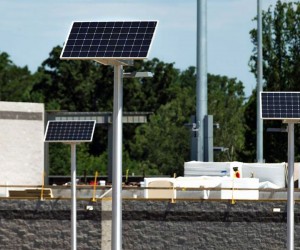
The system consists of solar cell components (including brackets), LED lights, control box (including controller and battery) and lighting poles to which they are mounted. The efficiency of the LED light provided by the solar panel is high. In the lamp part, 1W LEDs are integrated into the printed circuit board and arranged to illuminate with dot matrix at regular intervals as a plane light source.
The control box body is made of stainless steel, a durable material. A maintenance-free lead-acid battery and a charge-discharge controller are installed in the control box. The system uses sealed lead-acid batteries, also called “maintenance-free batteries” because they are rarely serviced. It is highly conducive to reducing system maintenance costs. The charge and discharge controller is designed with full functions (with light control, time control, overcharge protection, over discharge protection and reverse connection protection, etc.) and cost control to achieve high cost performance.
Working Principle
The working principle of the system is simple. The solar cell, made using the principle of photovoltaic effect, takes the radiation energy from the sun during the day and converts it into electrical energy output, which is stored in the battery through the charge and discharge controller. At night, when the illumination gradually decreases to about 10 lux and the open circuit voltage of the solar panel is about 4.5V, the charge and discharge controller will act after detecting this voltage value and the battery will discharge the lamp. After the battery is discharged for 8.5 hours, the charge and discharge controller will be activated and the battery discharge will end. The main function of the charge and discharge controller is to protect the battery.
System Design Ideas
Compared to general solar lighting systems, the design of solar street LED luminaires has the same basic principles, but there are more connections to consider. Solilamp will take these solar LED high-power street luminaires as an example and analyze it from various perspectives.
Solar Cell Module Selection
Design requirements:
- The load input voltage is 24V,
- Power consumption 34.5 W,
- Daily working time is 8.5 hours,
- Guaranteed to work on continuous rainy days for 7 days
The average annual radiation in the middle east region over the last two decades is 107.7Kcal/cm2, and after simple calculation the number of hours with the most intense sunshine is about 3.424 hours.
Daily power consumption = 12.2AH
Total charging current required for solar modules = 1.05×12.2×÷(3.424×0.85)=5.9A
Here, the shortest number of days between two consecutive cloudy and rainy days is 20 days, the comprehensive loss coefficient of the solar cell module system is 1.05, and the battery charging efficiency is 0.85.
The minimum total power of the solar modules = 17.2×5.9 = 102W.
The choice of standard battery components with a peak output power of 110 Wp and a single 55 Wp should be able to ensure normal operation of the solar LED street lighting system in most cases.
Battery Selection
Calculating the battery design capacity is simpler than the peak Watts of the solar modules.
According to the above calculation, the daily power consumption of the load is 12.2AH. When the battery is full, it can work continuously for 7 rainy days, also calculated as 12.2×(7 1) = 97.6 (AH), two 12V100AH batteries can meet the requirements.
Solar panels
Angle design
In order to ensure that the solar cell panels receive as much solar radiation energy as possible in a year, the most suitable inclination angle for the solar panels should be chosen.
Wind resistant design
A structural issue that requires great attention in the solar street lighting system is the design of the wind resistance. The wind resistance design is mainly divided into two parts, one is the wind resistance design of the battery module bracket, the other is the wind resistance design of the installed lighting pole.
Windproof design of solar cell module bracket
According to the technical parameter data of the battery module manufacturer, the highest upwind pressure that the solar cell module can withstand is 2700Pa. If the wind resistance coefficient is selected as 27m/s (equivalent to a tenth-degree typhoon) according to fluid mechanics, the wind pressure in the battery module is only 365Pa. Therefore, the component itself can withstand wind speeds of 27 m/s without being damaged. Therefore, the most important consideration in the design is the connection between the battery mounting bracket and the lighting pole.
In the design of the street lamp system, the connection design of the battery mounting bracket and lamp post uses a bolt post to fix the connection.
Wind resistant design of street lamp post
The parameters of street lights are as follows:
The inclination of the solar panel A = 16o, the height of the light pole = 5m
The design chooses the width of the weld seam at the bottom of the light pole δ = 4 mm, the outer diameter of the base of the light pole = 168 mm.
The surface where the source is located is the destruction surface of the light pole. The distance from the calculation point of the resistance moment W of the lamp post fault surface to the line of motion of the solar panel load F received by the lamp post is PQ = [5000 (168 6)/tan16o] × Sin16o = 1545 mm = 1.545 m. Therefore, the moment of wind load at the fracture surface of the light pole is M = F×1.545.
According to the design of the maximum allowable wind speed of 27m/s, the base load of the 2×30W double cover solar street light battery panel is 730N. Considering the 1.3 factor of safety, F = 1.3×730 = 949N.
Therefore, M = F×1.545 = 949×1.545 = 1466N.m.
According to the mathematical derivation, the moment of resistance of the circular fracture surface W = π×(3r2δ+3rδ2+δ3).
In the above formula, r is the inner diameter of the ring and δ is the width of the ring.
Moment of resistance to fracture surface W = π×(3r2δ+3rδ2+δ3)
=π×(3×842×4+3×84×42+43) = 88768 mm3
=88.768×10⁻⁶ m3
Stress caused by wind load moment = M/W
= 1466/(88.768×10-6) =16.5×10⁶pa =16.5 Mpa<<215Mpa
Among them, 215 Mpa is the bending strength of Q235 steel.
Therefore, the width of the weld seam chosen in the design meets the requirements and the wind resistance of the light pole is not a problem as long as the weld quality can be guaranteed.

DEPAR ENERGY SOLAR POWERED ROAD AND STREET LIGHTING POLE
Controller
The main function of the solar charge and discharge controller is to protect the battery. The basic functions are overcharge protection, over-discharge protection, light control, time control and anti-reverse connection etc. should have features.
Battery overcharge and overdischarge protection voltage is a general parameter. It changes the state of the circuit when the battery voltage reaches the set value.
The device selection currently includes single-chip microcomputers and comparators. There are many programs, each with its own features and advantages. The relevant program should be selected according to the needs and characteristics of the customer group.
Surface treatment
This series of products uses new electrostatic coating technology, mainly professional building materials coatings, which can meet customers' requirements for product surface color and environmental compatibility. At the same time, the product has high self-cleaning ability, strong corrosion resistance and aging resistance, suitable for all kinds of climatic environments. The processing technology is designed to be coated on the basis of hot-dip galvanizing, which meets the requirements in the most stringent conditions, which greatly improves product performance.

Leave a Comment